
Best Sunglasses Company for Men 2026: Top Performance and Heritage Brands
Human eyes are roughly ten times more sensitive to ultraviolet radiation than skin. While a sunburn on your shoulders might peel and heal within a week, the cumulative damage of UV rays on the ocular surface and internal structures—such as the lens and retina—is irreversible. Despite this physiological reality, the majority of men select their eyewear based on a three-second mirror test in a department store rather than an evaluation of optical clarity or frame engineering. The global eyewear market is a complex web of licensing agreements and manufacturing monopolies that often obscure the actual value of what you are wearing on your face.
The Monopolization of the Eyewear Industry and Why Brand Origin Matters
To understand which sunglasses company is truly the best, one must first understand the landscape of the industry. For decades, the market has been dominated by a few massive conglomerates, most notably EssilorLuxottica. This single entity owns Ray-Ban, Oakley, Persol, and Oliver Peoples, while also holding the licenses to produce eyewear for fashion houses like Chanel, Prada, and Giorgio Armani. When you buy a pair of designer frames, you are often paying for a logo stamped onto a frame produced in the same facility as a mid-tier mall brand. This vertical integration allows for massive profit margins but often leads to a stagnation in technical innovation.
Choosing the best sunglasses company for men requires looking beyond the marketing budget and focusing on companies that either remain independent or maintain a strict focus on specialized lens technology. Independent brands like Randolph Engineering or Salt Optics do not answer to the same cost-cutting pressures as conglomerate-owned entities. They often utilize higher-quality materials, such as Japanese titanium or Italian Mazzucchelli acetate, which offer superior strength-to-weight ratios. The distinction between a “fashion” brand and an “optics” brand is the first hurdle any informed buyer must clear. A fashion brand prioritizes the silhouette; an optics brand prioritizes how you see the world through the silhouette.
Furthermore, the manufacturing location serves as a proxy for quality control. While many mass-market frames are injection-molded in high-volume factories, premium companies still utilize handmade processes. For instance, high-quality acetate frames are cut from solid blocks, tumbled in wood chips for days to achieve a natural polish, and reinforced with internal wire cores. This process ensures that the frames can be heated and adjusted by an optician to fit the specific contours of a man’s face—a feature often missing from cheaper, rigid plastic alternatives. If a frame cannot be adjusted, it will never be comfortable for long-term wear, regardless of the brand name on the temple.
Key Players in Independent Eyewear
- Randolph Engineering: Family-owned, US-based, military-spec durability.
- Maui Jim: Now owned by Kering but still maintaining a proprietary lens-first philosophy.
- Serengeti: Specializes in photochromic and spectral control technology.
- Jacques Marie Mage: Ultra-limited production runs with extreme attention to historical detail.
Top-Tier Sunglasses Companies for Men: Performance vs. Heritage

When evaluating the best sunglasses company for men, the “best” depends entirely on the environment in which the glasses will be used. A pilot flying at 30,000 feet has vastly different requirements than a sailor in the Caribbean or a lawyer walking through Manhattan. The following companies represent the pinnacle of their respective niches, offering a blend of aesthetic timelessness and genuine technical utility.
Maui Jim: The Gold Standard for Polarization
Originally a small company selling sunglasses on the beaches of Lahaina, Hawaii, Maui Jim has become the benchmark for polarized lens technology. Their PolarizedPlus2® technology doesn’t just block glare; it enhances color using rare earth elements embedded in the lenses. For men who spend significant time near water or driving, the visual contrast provided by these lenses is unmatched. Their lenses come in four specific tints: Neutral Grey for bright light, HCL Bronze for variable conditions, Maui Rose for fast-moving sports, and Maui HT for low light.
Model Highlight: The Ho’okipa. Approximate Price: $230. Pro: Incredible lightweight rimless design. Con: The sporty aesthetic doesn’t pair well with formal tailoring.
Persol: The Icon of Italian Craftsmanship
Persol, derived from “per il sole” (for the sun), is the quintessential choice for the man who values heritage. Known for the patented Meflecto system—the world’s first flexible stem—Persol frames are designed to alleviate pressure on the sides of the head. Their signature silver arrow hinge is not just a logo; it is a functional piece of hardware that reinforces the frame’s most vulnerable point. Persol’s use of crystal (glass) lenses provides the highest level of optical clarity available, though it does add weight compared to polycarbonate alternatives.
Model Highlight: 649 Series. Approximate Price: $310. Pro: Timeless style made famous by Steve McQueen. Con: Glass lenses can be heavy during long days of wear.
Randolph Engineering: Military-Grade Durability
Since 2026, Randolph has been the prime contractor for aviator sunglasses for the US Department of Defense. Their frames are built to withstand the rigors of a cockpit, including high G-forces and integration with oxygen masks. The frames feature a 200-step manufacturing process and are finished in jewelry-quality metals like 23k gold or matte chrome. Their signature bayonet temples are designed to fit comfortably under headgear or helmets without creating pressure points. If you want a pair of glasses that can literally last a lifetime, this is the company.
Model Highlight: The Aviator. Approximate Price: $330. Pro: Solder joints are guaranteed for life. Con: The military aesthetic is very specific and less versatile than a Wayfarer style.
Oakley: The Leader in Athletic Performance
While often dismissed as too “aggressive” for casual wear, Oakley’s Prizm™ lens technology is a legitimate breakthrough in light filtering. By fine-tuning individual wavelengths of color, Prizm lenses emphasize the colors where the eye is most sensitive to detail. This is critical for sports like cycling or golf where reading the texture of the ground is paramount. Their O-Matter frame material is a nylon-infused plastic that is significantly more durable and heat-resistant than standard acetate.
Model Highlight: Holbrook. Approximate Price: $170. Pro: Highly impact-resistant and lightweight. Con: Lacks the premium “feel” of metal or high-grade acetate.
Lens Technology Comparison: Glass vs. Polycarbonate vs. CR-39
The frame is the fashion, but the lens is the function. Most men fail to realize that the material of the lens dictates not just the weight, but the Abbe value—a measure of the material’s optical dispersion. A low Abbe value means you will see more chromatic aberration (color fringing) at the edges of your vision. Choosing the right material involves a direct trade-off between clarity, weight, and safety.
| Material | Optical Clarity | Weight | Impact Resistance | Best For |
|---|---|---|---|---|
| Mineral Glass | Excellent | Heavy | Low | Driving, Casual Wear |
| CR-39 (Plastic) | Very Good | Moderate | Moderate | Daily Fashion Frames |
| Polycarbonate | Fair | Lightweight | High | Sports, High-Impact Activities |
| Trivex | Good | Very Light | High | Premium Performance |
Mineral glass remains the favorite for purists. It is the most scratch-resistant material and provides the truest color representation. However, it is brittle. If you drop your glasses on a concrete sidewalk, glass lenses are likely to shatter. For this reason, glass is rarely used in active sports eyewear. Polycarbonate, conversely, is virtually indestructible. It is the material used for bulletproof windows. While it is safe, it is prone to scratching and has the lowest optical clarity of the group. Trivex is the modern middle ground, offering the impact resistance of polycarbonate with significantly better optical performance, though it is often the most expensive option.
Beyond the material, consider the coating. A high-quality sunglasses company will apply a multi-layer anti-reflective (AR) coating to the back of the lens. This prevents light from bouncing off your own cheek and reflecting into your eye, a common cause of eye strain. Cheap sunglasses often skip this step, leading to distracting reflections. Furthermore, hydrophobic and oleophobic coatings are essential for keeping lenses clear of sweat, rain, and fingerprints. If a brand doesn’t specify these coatings, they likely aren’t there.
Always verify the VLT (Visible Light Transmission) percentage. Most category 3 sunglasses have a VLT of 8% to 18%, which is ideal for bright sunlight. If you are driving in overcast conditions, a category 2 lens with a higher VLT will provide better visibility and safety.
How to Select the Right Sunglasses Company Based on Face Shape and Use Case

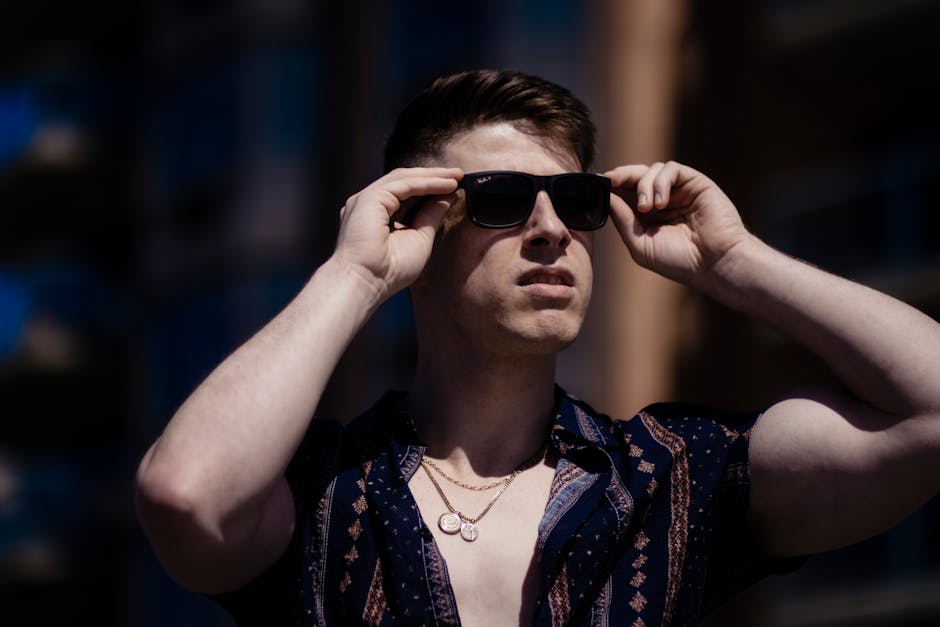
The most technically advanced lens in the world is useless if the frame doesn’t fit your face or your lifestyle. Choosing a sunglasses company should be a process of elimination based on your facial geometry. The general rule of thumb is to choose a frame shape that contrasts with your face shape. A man with a very round face should look for angular, rectangular frames to provide definition. Conversely, a man with a sharp, square jawline should opt for rounded or teardrop shapes—like the classic aviator—to soften his features.
Bridge fit is the most overlooked aspect of selection. If you have a shallow nose bridge, look for companies that offer “Asian Fit” or “Low Bridge Fit” options. These frames have enlarged nose pads that prevent the glasses from sliding down your face or resting on your cheeks. Brands like Oakley and Smith Optics are leaders in this area. If you have a wider head, look for brands that utilize spring hinges or have larger “temple-to-temple” measurements. Persol’s Meflecto system is particularly forgiving for wider faces, as the temples can flex outward without deforming the front of the frame.
Finally, consider the “Base Curve” of the lens. A 4-base curve is relatively flat and common in lifestyle or fashion frames. An 8-base curve is highly wrapped, hugging the face to provide peripheral protection. For high-glare environments like skiing or fishing, a high-base curve is essential to block light from entering through the sides. However, high-base curves can cause visual distortion if the lenses are not “decentered” (tapered in thickness toward the edges). This is where premium companies like Costa Del Mar or Smith excel; they engineer their wrap-around lenses to ensure that your peripheral vision is just as sharp as your central vision.
Practical Checklist for Your Purchase
- Measure your current frames: Look at the three numbers on the inside of the temple (e.g., 52-19-145). These represent lens width, bridge width, and temple length in millimeters.
- Check the hinge: A five-barrel or seven-barrel hinge is a sign of high-quality construction. Avoid flimsy single-screw hinges.
- Test the weight: If you plan to wear them for 8 hours a day, prioritize titanium or Trivex to avoid ear fatigue.
- Verify UV Protection: Ensure the lenses are rated for UV400, which blocks 99% to 100% of both UVA and UVB rays.
In the end, the best sunglasses company for men is one that respects the balance between physics and aesthetics. While the allure of a luxury logo is strong, the long-term health of your vision and the comfort of a well-fitted frame are the only metrics that truly matter. Whether you choose the rugged engineering of Randolph, the color-drenched optics of Maui Jim, or the classic Italian lines of Persol, investing in quality eyewear is a rare instance where the expensive choice is often the objectively better one.